

|
No matter how beautiful a
koi pond is, if the basics for a
successful koi pond are not incorporated during the
construction of the pond the owner will never be
satisfied with it. Koi ponds are unique to
themselves. The requirements for a successful water
garden or even a gold fish pond are minimal. On the
other hand, because koi fish are fast growing,
produce a lot of waste and need very good water
quality to flourish, they require a very special
pond. A successful koi pond will address these
issues, but at the same time it should be as easy as
possible to maintain. The following information is
provided to help you plan your “Perfect Pond”.
1)
How large should I make
my pond? One of the most common
mistakes people make with their first pond is that
they build it too small. For koi fish, the smallest
pond we recommend building is 1500 gallons, which
would be approximately 7 feet wide by 8 feet long
and 4 feet deep. That may sound huge to many
beginners, but most people who already have a koi
pond, will agree that if you build a pond much
smaller than that, you will not be happy with it.
The problem is that koi fish are extremely addictive
and it is hard to be content with just a few. Also,
keep in mind that you may start out with several 6
inch long koi, but within 3 or 4 years they could
grow to 24 inches or more. With few exceptions, most
people, after a while, wish they had made their
first pond bigger. On the other hand, you can also
make your pond too big. Bigger is not always better.
The largest pond we recommend building is 15,000
gallons, which would be approximately 17 feet wide
by 21 feet long and 6 feet deep. If you build a pond
much larger than that you run into several problems.
In a very large pond it can become almost impossible
to catch the fish if you need to. It can also be
very expensive to medicate the pond if that becomes
necessary. Additionally, all the water in the pond
will need to be filtered at least once every three
hours. Running pumps large enough to accomplish this
can cost several hundreds of dollars per month.
Finally, if you build the pond too large you may not
enjoy the koi as much, because in a very large pond
the koi are not always visible.
2)
Where should I place my
pond? There are several things to
consider. First, koi ponds do better in a shaded
area than in full sun. Full sun will work, but a
shaded area will generally slow the algae growth
down and will prevent the water from possibly
getting too hot during the summer months. If you
chose to build in a sunny area it might be practical
to think of building some type of arbor, either now
or in the future, to give your pond some shade.
Unlike a swimming pool, leaves from trees near the
pond should not create a problem
if the pond is properly designed.* In
many areas local building codes require any pond
deeper than 2 feet be within a fenced in area, which
could present a problem if you want to build it in
your front yard. Once you have chosen a general
location for the pond, we recommend you use a garden
hose to outline the exact location, size and shape
of the pond. This can be extremely helpful in giving
you a better idea of exactly how the pond will look.
After placing the hose where you plan to build the
pond, stand back and examine it from several
locations and ask yourself. “Will it be the size
pond that I want”? “Will it be as visible as I would
like it to be from, say, the back deck, the kitchen
window or wherever I would like to be able to see
it”? Keep in mind, this pond will most likely be
the central feature of your whole landscaping. Once
you have the general outline shape of the pond
established you can get a approximate idea of how
many gallons it would be by multiplying the (average
length) x (average width) x (average depth) x (7.5
gallons per cubic foot).
*One
note of caution:
Pine trees are the one
exception. Pine needles tend to create a real mess
in a koi pond. Unlike leaves, needles can travel
through the skimmer basket and the leaf basket on
the pump and end up in your pump impeller. If
possible, do not build a koi pond near a pine tree.
Redwood trees, although messy, are not near the
problem pine trees are.
3)
Can I grow plants in my
pond? If you really want to grow
plants in your koi pond you can,
but they really complicate
things. Here is why:
-
If you place shelves
in the pond to support the plants and the
shelves are less than 2 feet deep, you risk the
chance of loosing your koi to predators. Even if
the shelves are deeper than 2 feet below the
water level you may still have a problem. If
when you place a potted plant on the shelf and
the top of the pot is less than 2 feet from the
pond surface a blue heroin may wait until a fish
swims over the pot and then strike, pinning the
fish against the plant pot.
-
Most water plants do
not like water movement so you cannot use jets
in the pond. Therefore, most of the leaves that
fall in the pond will sink to the bottom before
they reach the skimmer and may have to be netted
out by hand.
-
Often times new
plants will have parasites on them so you will
need to treat them with potassium permanganate
before you introduce them to the pond.
-
If parasites do get
into your pond you will need to treat the whole
pond. Most chemicals used to treat for parasites
in koi ponds are toxic to plants. This means you
will need to remove all the plants while you
treat the pond. Additionally, you will need to
treat the plants separately before you return
them to the pond.
-
One of the most
effective ways to combat string algae in a koi
pond is to increase the salt level in the pond
to .4%. This is not an option when you have
plants in the pond because, most plants cannot
tolerate salt and will die.
-
Once koi get to be
12 inches or larger they begin to eat most
plants.
-
Most pond plants
begin to die back in the fall and create a real
mess in the pond.
-
Koi can hide under
the pond plants and this can create a potential
problem. If a koi gets sick and begins to
isolate itself, you may not notice it until it
is too late. Plus, if you need to catch a koi
for any reason it can be a real challenge
catching them among all the plants
Some people will argue that you must have plants in
the pond because the plants are necessary to consume
the nitrates that build up in the pond. That would
be true if it weren’t for all the algae that
naturally forms in a pond. A healthy pond will
normally develop a ¾ inch layer of green algae on
all the inside walls of the pond. This algae, which
feeds on nitrates just like pond plants do, is
usually more than sufficient to keep the nitrates at
a safe level.
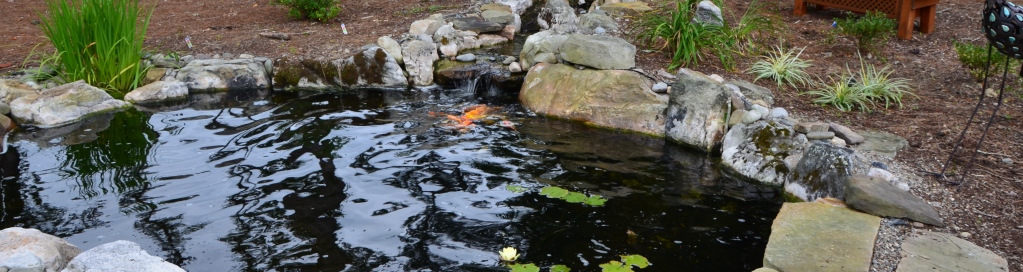
A
pond with plants in it can be very attractive, but
so can a well landscaped pond which has beautiful
plants surrounding it, yet with none actually in the
pond. Tom Holder (owner of Koi Care Kennel) built
this pond with the Advantage System on it and with
no plants in the pond. He has a healthy pond that is
both beautiful and very
easy to maintain.
4)
Which pond is better, a
rubber liner pond or a concrete pond?
They both have their own advantages. A concrete
pond, when designed and built properly, is more
permanent. ( You must make
sure it is designed and plumbed properly because it
is almost impossible to make changes later.)
The shape and contours can be very smooth and even.
The biggest disadvantage of a concrete pond is that
because of all the exposed concrete the ph tends to
be higher than ideal for at least the first three
years. This can easily be overcome by letting the
concrete cure and then coating the pond surface up
to the water line with a rubber base paint or epoxy.
A 45 mil rubber liner pond is not as permanent,
which can actually be a benefit. If the pond has
some design flaws that you need to change or you
need to remove the pond, a rubber liner is much
easier to work with. A real advantage is that liner
ponds tend to maintain a more neutral ph. The rubber
liner creates a very soft surface for the koi. Even
when a liner pond is installed properly you will
have a number of miner folds in the liner. Once the
pond is filled with water these folds become barely
visible. Rock work around the edge of a liner pond
can be a challenge if you don’t want the liner to
show. The reason is because the rock work will need
to extend down into the water and the mortar for the
rock work will not stick to the liner. ( To solve
this problem see “Advantage Pond Design Plans” under
“Rock Work”.) The problem of cutting a hole in a
liner for the bottom drains, jets, etc. is easily
overcome with the proper drains and bulkhead
fittings. When installed properly a liner pond can
easily be leak free for many years.
5)
How important is the
shape and bottom contour of the pond?
The shape of the pond is much more important than
most people realize. Many times people will get very
creative with the pond shape so that it rambles all
around the landscape and ends up looking like a
piece of a puzzle. Only after the pond is built and
filled with water dose the problem become apparent.
You can’t keep it clean. If the pond is shaped so
that it has dead areas where the water is not
moving, leaves and debris will collect there and
eventually sink. Additionally, the bottom contour of
the pond is equally important. Flat bottom
ponds require constant vacuuming to keep them clean.
If you are retired and have two hours each day to
clean your pond you can build it any shape you wish.
On the other hand, if you want to build a pond that
is almost “self cleaning” pay close attention to
both the shape of the pond and the inside contour
leading from the edges of the pond all the way to
the bottom drains. We can’t
express enough how important the contour of a koi
pond is. A well designed pond shape and
contour can save you many hours of back breaking
work and help provide a healthier environment for
the koi. See the “Advantage Koi Pond Plans” for more
details on pond shape and bottom contour.
6)
How deep should I make
the pond? A serious koi pond should
be at least 3 feet deep and no areas should
be shallower than 2 feet. Any areas shallower than 2
feet is an open invitation to dinner for both blue
herons and raccoons. If you don’t think you have
predators in your neighborhood just build a shallow
pond and watch what happens! Even a single safety
step to help you get out of the pond, that is less
than 2 feet deep, can cost you most of your fish.
Also, all sides should go almost straight down, not
tapered. “Aquascape” type ponds where the sides of
the pond gently taper in toward the bottom will not
work for koi. Even if you build a “deep area” for
the fish with a cave in it, for them to hide in, you
are still not safe. Blue herons will wade out into
the water, stand perfectly still, and simply wait
for the koi to come out and then strike.
Do not place shelves for
plants in the pond. You can hang potted
plants over the side with wires to support them.
That way if you start having problems you can simply
remove them. If you decide to ignore this advice you
will probably ( after loosing your favorite fish)
end up covering your pond with a net or in one case
I saw ½ inch rebar used to keep out raccoons. Most
people would agree that a beautiful pond is somewhat
ruined when it has to be covered with something to
protect the fish. A deep pond with steep sides is
the best defense against predators. Koi fish get
their exercise by swimming up and down in a pond
rather than horizontally. Therefore, if you plan on
growing “jumbo koi” you will need to build the pond
at least 6 feet deep.
7)
How important is the
filter? The filter is
the heart of your koi pond.
The filter is what keeps the water clear and healthy
for the fish. Many ponds have failed because the
owners spent all their money on a beautiful pond and
tried to save money on their filter. The filter
serves two purposes. One, it serves as a
mechanical filter
removing fish waste and anything else in the pond
that would cloud the water. Two, it serves as a
biological filter
by converting the ammonia produced by the fish into
nitrites and eventually into nitrates which, in
general, are harmless to the fish. Some filters can
be very high maintenance requiring constant
attention while others can be very easy to maintain.
Rule number one, when it comes to filters, “You can
never have too big a filter.” When choosing a
filter, selecting a filter that is slightly
oversized for your pond can be a very wise
investment
8)
How far away from the
pond can I install the filter system?
The Advantage Bead Filters have the advantage of
being a pressurized system. That means the filters
can be installed some distance from the pond making
it easier to hide. For long runs from 50 feet to 300
feet, the diameter size of the pipe traveling to and
from the filter may need to be increased, up to 3
inches, depending on the size of the pond.
9)
Do I need a pre-filter?
A pre filter is designed to collect solid material
such as leaves, fish waste and string algae before
they get to your filter. In some small ponds, the
pump and skimmer baskets may be sufficient. The
larger the pond, the more debris it will produce,
therefore, the more important they become. Pre
filters are especially important if you have a
filter that is hard to clean such as a gravel type
filter, because you usually are only cleaning them
once or twice a year. The more waste you can keep
out of them, the less often you will have to clean
them. Pre filters are not
as important with a good bead filter because you can
easily remove the waste from the filter whenever
necessary.
There are basically
3 types of pre filters:
-
A simple holding tank,
made of concrete or fiberglass, with rows of
brushes or mat material suspended in it to
capture debris before it gets to the pump. A
typical tank may be 5 feet square and 2 to 3
feet deep. This type of pre filter will require
you to regularly remove and clean the brushes or
mat material
-
Vortex pre filters
are shaped like a big round tub that is tapered
at the bottom. Water enters from the side at an
angel which causes the water to rotate in the
tub. This causes any debris to drift to the
outer wall and then sink to the bottom of the
tank where it can be drained out when needed.
Clean water exits from a pipe in the center.
Vortex filters may require a large hole to set
in and in some situations, a sump pump to drain
them.
-
The “Advantage Collector
Box” is a fiberglass box with a large
rigid net in it. The large model has 4 openings,
each with a slide valve that allow you to select
up to 4 different sources from where the water
is to be drawn from. The medium model has 3
openings. With the valves you can easily
regulate the flow from each source and on
occasion, flush one line at a time to reduce the
chance of debris collecting in the pipes. It
requires the least amount of space and is
probably the easiest to clean. It is designed
for ponds 6,000 gallons and larger.
10)
What size pump will I need?
In selecting a pump you have one simple
goal in mind. To move the proper amount of water for
the least amount of money. The hard part is to
estimate how much water you need to move. Here are
some things to consider. Ideally, you want to send
all your pond water through the filter at least
once every 2 to 3 hours. We also recommend sending
water through some jets on the sides of your pond.
(see #14 How important is it to have jets?). Are you
going to have a water fall? If so, how high will it
be? What kind of filter will you be using? Is it
important that the pump be quiet? All these factors
have to be considered before you select a pump. Make
sure you purchase an efficient pump built for koi
ponds. Your pump will be running 24 hours a day. An
inefficient pool type pump can cost you an extra
$100.00 a month in electricity.
11)
What size pipe should I
use?
Pipe size is extremely important on koi
ponds. Pool builders will often use smaller diameter
pipe when building a swimming pool because it is
cheaper and easier to work with. They can easily
overcome the restriction caused by the smaller pipe
by using large high pressure pool pumps. This is
acceptable because they usually only run these pumps
4 to 6 hours a day. Koi ponds, on the other hand,
must move large volumes of water 24 hours a day. The
smaller you make your pipe, the more pressure it
will require to move water through it. Pumps are
rated by how much water ( gallons per minute) they
can move at a certain amount of head pressure. 1
foot of head pressure is the amount of pressure
required to push water up vertically 1 foot.
Example: To move 20 gallons of water per minute
through 50 feet of 1 inch pipe would require 11.4
feet of head pressure. If you increased your pipe
size from 1 inch to 2 inch your head pressure would
drop to .4 feet of head. The lower you keep your
head pressure, the smaller, more efficient pump you
can use. This can save you a lot of money
over the years.
12)
How important is it to have a bottom drain?
Another common mistake that is almost
impossible to correct after the pond is built is
failure to install a bottom drain.
Bottom drains are a must
for a successful koi pond. To maintain proper water
quality you need to get the fish waste into the
filter so it can be removed from the system. Without
a bottom drain, the best filter in the world cannot
do it’s job properly. Some ponds may require several
bottom drains. That shows how important they are to
a successful pond. Some manufacturers would have you
believe that a bottom drain is not required. By
simply placing rocks on the bottom of the pond and
allow beneficial bacteria to grow in the rocks you
will duplicate what you find in nature and
everything will be just fine. The problem with that
reasoning is that in nature you often have a
constant supply of fresh water entering the river or
lake and the fish population is usually about one
fish per 30,000 gallons whereas, in a koi pond you
are constantly recycling
the same water over and over again and
the fish population averages about
one fish per 150 gallons.
Unless you only put one koi in your pond and change
the water constantly you can’t duplicate nature.
What works in nature will not work in a koi pond.
Also, as leaves collect and begin to decay amongst
the rocks, they produce tannin acid which, though it
doesn't bother the fish, will turn the water a brown
dirty looking root beer color. The only way to get
clear water again is to drain the pond and power
wash the rotting leaves from between the rocks. This
is a major job which, at best, provides only a
temporary fix until the leaves again collect in the
rocks. Additionally, this whole cleaning process is
extremely stressful to any koi in the pond since
they will need to be netted up and stored while the
pond is cleaned and will then be placed back into a
pond that has experienced a 100% water change and
the whole ecological balance of the pond has been
changed. This whole experience can be avoided by
simply leaving out the rocks, installing a bottom
drain and contouring the bottom, so that any fish
waste or leaves that end up on the bottom of the
pond will work their way to the drain and be
removed.
13)
How important is it to have a skimmer?
A skimmer can make the difference between
enjoying a pond and beginning to resent it after a
while. A properly functioning skimmer will collect
the leaves and anything else that lands on the
surface of your pond into a net or basket, where it
can be easily disposed of. Without a skimmer, you
are sentenced to a life of constantly cleaning
leaves and debris from your pond. They are a real
bargain when you consider the minimal expense they
add to your pond. Note: Even if you plan to build
your pond inside your house, where there would be no
leaves, you should still install a skimmer because
in addition to leaves, they skim off the “dissolved
organic compounds” (DOC). Dissolved organic
compounds will form in any pond and if not removed
will causes an unsightly film and bubbles on the
surface of the pond. A skimmer removes this film by
constantly skimming off the top surface of the pond.
14)
How important is it to have jets?
Jets are very often overlooked by beginners
when building a pond. Anyone who has ever had
properly installed jets in their pond would never
consider building a pond without them. Jets have
several wonderful benefits. They provide exercise
for the fish because they love to swim in the
current. By installing the proper type of jets, in
the right location and depth in a pond, they can be
used to direct leaves toward the skimmer making the
skimmer much more effective. In addition, as the
water from the jets breaks the surface of the pond
it picks up considerable amounts of oxygen thus
increasing the overall oxygen level of the pond.
15)
How important is it to have an auto-fill?
An auto-fill
is one of those features that if you install one you
will love it. It makes maintaining a pond much
easier. An auto-fill does just what the name
implies. It will automatically keep the pond water
at the same level all the time. As water evaporates,
it will automatically replace it. They are
especially useful if you have a bead filter, because
each time you backwash the filter the auto fill will
replace any water used during the process. Too often
you hear of someone turning on the hose to add water
and then forgetting to turn it off only to later
find all their koi dead. This is because whenever
you replace more than 10% of your pond water at any
one time, with city water, you need to add a
dechlorinater to neutralize the chlorine in the
water which is toxic to fish. With an auto-fill you
don’t run the risk of forgetting to turn off the
water. Under normal use it is generally not
necessary to add dechlorinator to the pond each time
the auto-fill comes on because it is only replacing
such a small percentage of water. Again, the
exception would be if you were replacing more than
10% of the pond water at any one time.
16)
Do I need to install an
ultraviolet light?
New ponds are especially prone to algae blooms until
the whole ecological system of the pond matures
which may take several years. Ultraviolet lights are
designed to kill any algae floating in the water.
Algae blooms in ponds can turn a perfectly clear
pond into a thick pea soup looking pond in a short
period of time. The way ultraviolet lights work is
when the algae in the water passes through the unit
it is exposed to a very bright ultraviolet light.
This energy from the light destroys the DNA in the
algae which in turn causes it to eventually die. As
the algae cells die they will begin to stick
together so that they can be filtered out of the
water. Selecting the proper size light is very
important. If the light is not big enough for the
pond that it is installed on you will notice almost
no effect. Additionally, if the water flow through
the light is too fast it will also reduce the
efficiency of the light to where it has little
effect. Ultraviolet lights are not effective against
string type algae because it attaches to the pond
and does not flow through the light.
17)
Should I install under
water lights in my pond? Under water
lights installed in a pond extends the enjoyment of
the pond beyond the daylight hours. The pond takes
on a completely different look at night with lights
in it. At night, because there is no glare from
sunlight on the pond surface, the koi become more
visible than ever. The only complaints we ever hear
about pond lights is that “I wish we had installed
more lights when we built the pond”. We usually
recommend installing several or more lights in a
pond, depending on the size of the pond. Generally,
the purpose of adding lights to a koi pond is to
light up the koi not just the pond When you only add
one light to a pond you often times end up with one
stream of light shining across the pond while much
of the pond is still in the shadows. With several
lights coming from different angles the whole pond
lights up and thus the koi become very visible.
18)
Should I install an
automatic feeder on my koi pond?
Automatic feeders have their place. If you have a
large pond and you want your koi to grow as fast as
possible, then install an automatic feeder and feed
them a high protein food 5 times a day during the
whole summer. On the other hand, if you just want
something to relieve you of the responsibility of
feeding your koi daily I would encourage you to save
your money and find the time to do it yourself even
if it is only once a day. By feeding your koi on a
daily basis you will become familiar with how they
respond to the food. This is invaluable! The first
time you feed them and you notice one or more of
them responding differently, you know something is
wrong. It could be something as simple as your water
chemistry is off or something more serious such as
parasites. Whatever it is, you will be able to get a
jump on it before it becomes a real problem. When
you go on vacation just ask your neighbor if he or
she would mind coming over once a day and throwing
some food in the pond. Most neighbors would jump at
the chance. The real advantage of your neighbor
feeding you koi while you are on vacation rather
than some machine, is that if there is a problem
they can call someone.
19)
How many koi can I put
in my pond?
This is a good question and a hard one to
answer. There is an optimum number of koi for each
pond. The problem is, that number keeps changing. A
well built 1500 gallon pond will easily sustain 30
koi 6 inches long. Two years later when those same
30 koi are now all 18 inches long you have a real
problem, because your pond is now over stocked.
Because people tend to overstock their ponds, all
the Advantage Koi Pond System Kits, were designed to
have an oversized filter on them. This means that
the limiting factor for how many koi you can keep in
your pond will not be
limited by the filtering system. Rather,
the limiting factor will be how crowded the koi look
in the pond. Even with perfect water quality when
the koi become too crowded their immune system
begins to slow down and they begin to have problems.
The best way to judge how many koi to keep in a pond
with the Advantage System is simply to examine how
crowded they look. If they can’t swim in a relaxed
fashion it is time to remove some even though the
water quality tests fine.
20)
What should I look for
when selecting someone to build my koi pond?
Do not make the costly mistake of assuming that your
landscaper or contractor knows how to build a koi
pond correctly. You need to do your homework and
give some serious thought as to how you want your
koi pond to turn out. Review the previous questions
and make notes as to what is important to you and
what is not. How big do you want the pond to be? How
important is it to you that the pond be easy to
maintain? How much do you want to spend on the pond?
You need to have clear in your mind what kind of
pond you want. Then, when selecting someone to build
your pond, interview them concerning their
workmanship and experience. If you can find someone
who specializes in building koi ponds, that might be
helpful. The reason I say it might be helpful
is because sometimes people who only build koi ponds
have one set way of building them and are not open
to changes. With today’s new technology you can
create a pond that will not only give you better
water quality, but one that will be so much easier
to maintain than what was offered just 8 years ago.
Unless you and your builder can agree, beforehand,
on exactly how you want your pond to be
built, the whole experience could be a disaster. For
example: One customer contracted to have a formal
shaped 3,000 gallon pond built “exactly”
according to the “Advantage Koi Pond Design Plans”
for a 3,000 gallon pond. He was a very busy doctor
who needed a pond that was as easy to maintain as
possible. The contractor continued to assure him, as
he was building the pond, that he was following the
plans exactly. When the pond was finally completed
it was beautiful to look at with it’s slate
waterfall and edges. At night, the lights he
installed help create a wonderful sight. The problem
was that there was no gradual contour leading from
the sides of the pond to the bottom drain. The
contractor had completely ignored the recommended
bottom contour so the waste would be removed
automatically and instead made the whole bottom
flat. The result is that, now the owner has to, on a
weekly basis, vacuum the bottom of his pond to keep
it free of debris. Needless to say, the owner is
furious with the contractor. The lesson from this
example is that you really need to get involved in
the design of your pond. Don’t leave it all up to
your contractor. Listen to his advice but it is up
to you to make sure it is being built correctly. If
you need a second opinion, feel free to give us a
call at Sacramento Koi.
|